
Concrete Bag Calculator: Calculate Concrete Bags, Cost & Load Tips
Calculate exactly how many concrete bags you need with zero guesswork. Our advanced tool factors in project wastage and total costs while providing pro loading tips to save you time and money on every pour.
Concrete Bag Calculator
Our Concrete Bag Calculator helps you instantly estimate the number of concrete bags required for your project based on total concrete volume, selected bag size, and waste allowance. It also calculates the total concrete volume in cubic meters (m³), cubic feet (ft³), and cubic yards (yd³), making it easier for homeowners, DIY builders, and professional contractors to plan accurately.
The calculator supports popular bag sizes like Quikrete High Strength 80 lb, Sakrete High Yield 80 lb, Standard Mix 60 lb, and Fast-Setting Mix 50 lb, along with an optional wastage percentage to cover spillage, uneven ground, and formwork loss.
Instead of guessing, use precise calculations based on industry-standard formulas to avoid under-ordering, over-ordering, and expensive short-load delivery fees.
How to Use the Concrete Bag Calculator
Using the bag calculator is simple and takes less than a minute. Follow these steps to get accurate concrete bag estimates for your project.
Step 1 — Select Your Project Type
Start by choosing what you are building.
Common project types include:
- Walkways and patios
- Post holes and footings
- Driveways and slabs
Each project type may require a different concrete strength recommendation, such as 2500 PSI, 3000 PSI, or 4000 PSI, depending on load and usage.
For example:
- Post holes and footings → 2500 PSI
- Walkways and patios → 3000 PSI
- Driveways and slabs → 4000 PSI
Selecting the correct project type improves both strength planning and material estimation.
Step 2 — Enter Concrete Volume
Next, enter the total volume of concrete required for your project.
If you do not know the volume yet, you can calculate it first using our free Concrete Calculator, which supports different shapes like:
- Square and rectangular slabs
- Circular slabs
- Tube footings
- Columns
- Stairs
- Walls
- Footings
Simply enter your dimensions there to get the exact concrete volume, then use that result inside the Concrete Bag Calculator.
This ensures your estimate starts with accurate measurements.
Step 3 — Choose Units in Concrete Bag Calculator
Select the unit you want to use for concrete volume.
Supported units include:
- Cubic Feet (ft³)
- Cubic Yards (yd³)
- Cubic Meters (m³)
This makes the calculator useful for both U.S. projects and international construction work.
For example:
- Most U.S. suppliers use cubic yards
- DIY bag calculations often use cubic feet
- International projects commonly use cubic meters
The tool automatically converts values between units for better accuracy.
Step 4 — Select Bag Size
Choose the concrete mix type and bag size you plan to purchase.
Supported options include:
- Quikrete High Strength (80 lb)
- Sakrete High Yield (80 lb)
- Standard Mix (60 lb)
- Fast-Setting Mix (50 lb)
Each bag type produces a different concrete yield.
For example:
- 80 lb bag ≈ 0.60 cubic feet
- 60 lb bag ≈ 0.45 cubic feet
- 50 lb bag ≈ 0.37 cubic feet
Selecting the correct bag size ensures the final estimate matches your actual material purchase.
Step 5 — Add Waste Allowance
Construction projects always involve some level of waste. That is why we recommend adding a 5% to 10% waste allowance for:
- Spillage during mixing
- Uneven subgrade
- Formwork shifting
- Surface variations
- Leftover concrete inside the mixer
Simply move the wastage slider, and the calculator will automatically update your results in real time. This gives you a safer estimate and helps prevent running short during the pour.
Formula Used in the Sack Concrete Calculator
The Concrete Bag Calculator uses a simple industry-standard formula to estimate how many ready-mix concrete bags are required for your project.
The calculation is based on:
- Total concrete volume required
- Yield of one concrete bag
- Waste allowance percentage
Basic Formula for Concrete Bags Required
Bags Required = (Total Concrete Volume ÷ Yield Per Bag) + Waste Allowance
How This Formula Works in Concrete Bag Calculator
First, the calculator takes your total concrete volume in:
- Cubic Feet (ft³)
- Cubic Yards (yd³)
- Cubic Meters (m³)
Then it checks the selected bag size and its standard yield.
For example:
- 80 lb bag ≈ 0.60 cubic feet
- 60 lb bag ≈ 0.45 cubic feet
- 50 lb bag ≈ 0.37 cubic feet
After that, the tool adds your selected waste factor (usually 5% to 10%) to prevent shortages caused by spillage, uneven surfaces, and leftover concrete in the mixer. Finally, the result is rounded up because concrete bags cannot be purchased in decimals.
This gives you a practical estimate for real-world construction projects instead of just a perfect mathematical volume.
Example Calculations of Concrete Bag Calc
Real examples make concrete estimation much easier to understand. Below are common project examples showing how the Concrete Bag Calculator works for patios, fence posts, and driveways.
These examples help homeowners, contractors, and DIY builders quickly estimate materials before starting a project.
Example 1 — Patio Slab
Project:
You want to build a backyard patio slab that is:
- Length = 10 feet
- Width = 10 feet
- Thickness = 4 inches (0.33 ft)
Volume Calculation:
Concrete Volume:
10 × 10 × 0.33 = 33 cubic feet
Using 80 lb Quikrete High Strength bags:
33 ÷ 0.60 = 55 bags
Adding 5% waste allowance:
Final estimate = 58 bags
Result:
You will need approximately 58 bags of 80 lb concrete mix for a 10×10 patio slab.
This is one of the most common residential concrete projects.
Example 2 — Fence Post Hole
Project:
You need concrete for one fence post hole with:
- Diameter = 12 inches (1 ft)
- Depth = 3 feet
Volume Calculation:
Using circular footing formula:
π × r² × h
π × (0.5)² × 3 = 2.36 cubic feet
Using Fast-Setting Mix 50 lb bags:
2.36 ÷ 0.37 = 6.37 bags
Rounded up:
Final estimate = 7 bags
Result:
You will need approximately 7 bags of 50 lb fast-setting concrete mix for one fence post hole.
This is ideal for deck posts, fencing, and mailbox installation.
Example 3 — Small Driveway
Project:
You want to pour a small driveway section:
- Length = 12 feet
- Width = 20 feet
- Thickness = 5 inches (0.42 ft)
Volume Calculation:
12 × 20 × 0.42 = 100.8 cubic feet
Using Sakrete High Yield 80 lb bags:
100.8 ÷ 0.67 = 150 bags
Adding 8% waste factor:
Final estimate = 162 bags
Result:
You will need approximately 162 bags of 80 lb concrete mix for this small driveway.
At this size, many contractors start comparing bagged concrete vs ready-mix delivery.
What Is a Concrete Bag Calculator?
A Concrete Bag Calculator is a construction estimating tool used to determine how many ready-mix concrete bags are required for a specific project. It converts your total concrete volume into the exact number of bags needed based on the selected mix type and bag size.
This tool is commonly used for:
- Concrete slabs
- Walkways and patios
- Fence post holes
- Footings and foundations
- Driveways
- Sidewalks
- Sonotube footings
- Small residential construction projects
Instead of manually calculating concrete volume and bag yield, the calculator does the work instantly using standard formulas followed by trusted suppliers like QUIKRETE and Sakrete.
Why Accurate Concrete Estimation Matters
Concrete is one of the most expensive materials in small construction projects, and mistakes happen.
If you order too little concrete:
- Work stops in the middle of the pour
- Cold joints may weaken the structure
- Extra delivery charges may apply
- Short-load fees can increase project costs
If you order too much concrete:
- You pay for unused material
- Extra labor is needed for disposal
- Wasted concrete increases the total project cost
That is why professional contractors always calculate before pouring.
Why Guessing Is a Bad Idea
Many people estimate concrete by “eyeballing” dimensions, especially for patios, slabs, and footings. This often leads to inaccurate orders because real-world factors like uneven subgrade, formwork movement, and mixer retention are ignored.
Even a small mistake in slab thickness can significantly change the number of required bags.
For example, changing the slab depth from 4 inches to 5 inches can increase material needs by more than 20%.
How This Bag Concrete Calculator Saves Money and Labor
Using a concrete bag estimator helps you:
- Order the correct number of bags
- Reduce material waste
- Avoid delivery penalties
- Estimate total project cost
- Plan labor requirements better
- Compare bagged concrete vs ready-mix options
Adding the recommended 5–10% waste factor also improves accuracy for real-world job site conditions.
This makes the calculator useful for both DIY homeowners and construction professionals who need fast, reliable estimates.
Concrete Bag Sizes — Which One Should You Buy?
Choosing the right concrete bag size is just as important as calculating how many bags you need. The best option depends on your project size, lifting capacity, budget, and how quickly you want to complete the pour.
Many people automatically choose the largest bag, but that is not always the smartest decision.
Below is a simple comparison to help you decide.
40 lb vs 60 lb vs 80 lb Concrete Bag Sizes Comparison
| Bag Size | Approximate Yield | Best For | Weight Handling | Main Advantage | Main Limitation |
| 40 lb | 0.30 ft³ | Small repairs, patch jobs | Easy | Lightweight and easy to carry | More bags needed |
| 50 lb | 0.37 ft³ | Fence posts, deck posts | Moderate | Fast-setting options available | Less efficient for large slabs |
| 60 lb | 0.45 ft³ | Sidewalks, patios, small slabs | Balanced | Good mix of weight + yield | Still many bags for big pours |
| 80 lb | 0.60 ft³ | Driveways, slabs, foundations | Heavy | Best for large pours and cost efficiency | Harder to lift repeatedly |
Which Bag Size Is Best?
Choose 40 lb Bags If:
- You are doing small repair work
- You prefer easier lifting
- You are working alone
- You need only a few bags
Choose 60 lb Bags If:
- You are pouring patios or walkways
- You want a balance between weight and coverage
- You need moderate project efficiency
Choose 80 lb Bags If:
- You are working on driveways or slabs
- You want fewer total bags
- You want better cost efficiency per cubic foot
- You have help for lifting heavy bags
Most contractors prefer 80 lb bags from QUIKRETE or Sakrete for large pours because they reduce labor and mixing time.
How Many Bags of Concrete Do I Need? (Quick Reference Chart)
Many users want a fast answer before using the calculator. This quick reference table shows common project sizes and estimated bag counts using standard 80 lb concrete bags.
Actual results may vary depending on waste allowance and the mix brand.
Quick Concrete Bag Reference Table
| Project Type | Dimensions | Estimated Bags Needed (80 lb) |
| Fence Post Hole | 12″ diameter × 3 ft deep | 7 bags |
| Small Patio Slab | 10 ft × 10 ft × 4 in | 58 bags |
| Medium Patio | 12 ft × 12 ft × 4 in | 84 bags |
| Walkway | 4 ft × 20 ft × 4 in | 45 bags |
| Small Driveway | 12 ft × 20 ft × 5 in | 162 bags |
| Shed Base | 8 ft × 10 ft × 4 in | 47 bags |
This table helps users estimate faster before using the full calculator for exact results.
Bags vs. Ready-Mix Concrete — Which Is Right for Your Project?
One of the biggest questions homeowners ask is:
Should I buy concrete bags or order ready-mix concrete?
The answer depends mostly on your project size.
For small jobs, bagged concrete is usually cheaper and easier. For larger pours, ready-mix trucks often save time, labor, and money.
Quick Decision Table
| Project Size | Best Option | Why |
| Fence posts | Bagged Concrete | Small volume, easy DIY |
| Small patio | Bagged Concrete | Affordable and manageable |
| Walkways | Bagged Concrete | Good for smaller pours |
| Large driveway | Ready-Mix | Too many bags required |
| Foundation slab | Ready-Mix | Faster and more consistent |
| Large commercial work | Ready-Mix | Professional-grade delivery |
When Concrete Bags Make Sense
Choose bagged concrete when:
- Your project needs less than 1 cubic yard
- You want DIY installation
- Delivery access is limited
- You only need a few pours
When Ready-Mix Is Better
Choose ready-mix when:
- Your project exceeds 1 cubic yard
- You need consistent strength across a large pour
- Labor costs are high
- Mixing dozens of bags becomes inefficient
As a simple rule:
If your project needs more than 45 bags of 80 lb concrete, it is smart to compare ready-mix truck pricing.
Concrete Strength Guide — What PSI Do You Need?
PSI means Pounds per Square Inch, and it measures how strong concrete becomes after curing.
Choosing the right PSI matters because different projects need different strength levels.
Most DIY users choose the wrong PSI because they do not know what each strength level is designed for.
2500 PSI vs 3000 PSI vs 4000 PSI
| Concrete Strength | Best For | Why |
| 2500 PSI | Post holes, footings | Light structural support |
| 3000 PSI | Walkways, patios, sidewalks | Standard residential use |
| 4000 PSI | Driveways, slabs, and garage floors | Handles vehicle loads |
Easy Rule for Homeowners
Use 2500 PSI For:
- Fence posts
- Deck footings
- Light support areas
Use 3000 PSI For:
- Patios
- Sidewalks
- Garden paths
- Residential walkways
Use 4000 PSI For:
- Driveways
- Garage slabs
- Structural slabs
- Areas with vehicle traffic
Higher PSI does not always mean better; it means stronger concrete for heavier loads.
Using the right PSI helps balance both performance and project cost.
Don’t Forget the Waste Factor — Why You Should Always Add 10%
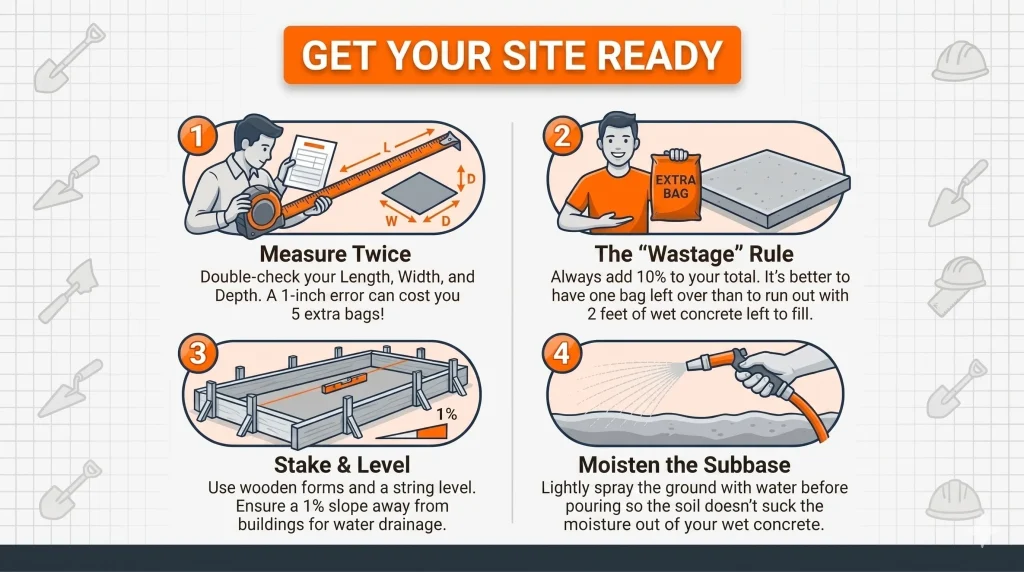
One of the biggest mistakes people make when using a Concrete Bag Calculator is calculating only the “perfect” volume and forgetting the real-world waste factor.
On paper, your math may look exact. On the job site, concrete rarely works that way.
That is why professional contractors, concrete suppliers, and builders usually recommend adding 5% to 10% extra concrete to every project, and in many cases, 10% is the safest choice.
Skipping this step often leads to:
- Running out of concrete before the pour is finished
- Emergency trips to buy more bags
- Extra delivery charges or short-load fees
- Weak cold joints caused by interrupted pours
- Higher labor costs and project delays
A small overestimate is always better than being one bag short.
Why Concrete Waste Happens
Even when measurements are accurate, several real-world conditions increase concrete usage.
1. Over-Excavation
When digging for footings, fence posts, or slab preparation, holes are often slightly deeper or wider than planned. Even a small difference can significantly increase total concrete volume.
Example:
A fence post hole dug 2 inches wider than planned may require several extra bags across multiple posts.
2. Spillage During Mixing and Pouring
Concrete is heavy and messy.
Some material is naturally lost during:
- Wheelbarrow transport
- Mixer discharge
- Bucket pouring
- Shovel handling
- Formwork overflow
This is especially common with DIY projects using bagged mixes like QUIKRETE and Sakrete.
3. Uneven Ground or Subgrade
If the ground beneath your slab, patio, or walkway is not perfectly level, the concrete depth becomes inconsistent. That means your project often needs more material than the original plan.
This is extremely common for:
- Backyard patios
- Garden walkways
- Driveways
- Garage slabs
- Shed bases
4. Formwork Bulging
Wooden forms can flex slightly under wet concrete pressure, especially on larger pours. This small expansion increases total volume more than most people expect.
The Simple 10% Rule
The safest formula is:
Final Concrete Needed=Calculated Volume×1.10\text{Final Concrete Needed} = \text{Calculated Volume} \times 1.10Final Concrete Needed=Calculated Volume×1.10
This means: If your calculator shows: 50 bags needed
You should order: 55 bags
Those extra 5 bags can save hours of work and prevent expensive mistakes.
Recommended Waste Factor by Project Type
| Project Type | Recommended Waste Allowance |
| Fence Post Holes | 10% |
| Patio Slabs | 5–8% |
| Walkways | 5–8% |
| Driveways | 8–10% |
| Foundations | 10% |
| DIY Projects | Always 10% |
For beginners, the best advice is simple: Always plan for 10% extra concrete. Professionals do it for a reason.
How to Mix Bagged Concrete — Quick Tips Before You Pour
After calculating how many bags of concrete you need, the next important step is mixing it correctly. Even the best calculator cannot fix poorly mixed concrete.
Too much water, rushed mixing, or hot weather mistakes can weaken the final strength of your slab, patio, driveway, or footing. Whether you use QUIKRETE, Sakrete, or another ready-mix product, these quick tips help ensure better results.
1. Follow the Recommended Water Ratio
Adding too much water is one of the most common DIY mistakes. Yes, wetter concrete is easier to pour but it also becomes weaker.
Always follow the manufacturer’s instructions on the bag.
Typical example:
- 80 lb bag = about 6 pints of water
- 60 lb bag = about 4.5 to 5 pints of water
Too much water can cause:
- Cracking
- Shrinkage
- Reduced PSI strength
- Weak surface finish
The goal is workable concrete, not watery concrete.
2. Add Water Slowly
Never dump all the water in at once. Start with about 80% of the required water, mix thoroughly, then slowly add more if needed.
This gives you better control over consistency. Concrete should look like thick oatmeal, not soup.
3. Use the Right Mixing Method
For small jobs:
- Wheelbarrow + shovel works fine
For medium to large projects:
- A portable concrete mixer saves major labor
For large slabs:
- Ready-mix truck delivery is often smarter than mixing dozens of bags
If your project needs more than 40–50 bags, compare ready-mix pricing first.
4. Don’t Over-Mix
Mixing too long can weaken the material and reduce workability.
Usually:
3 to 5 minutes of proper mixing is enough
The goal is uniform consistency without dry pockets.
5. Watch the Temperature
Hot weather makes concrete set faster.
Cold weather slows curing dramatically.
Best temperature range for pouring:
50°F to 75°F (10°C to 24°C)
Avoid:
- Extreme summer heat
- Freezing temperatures
- Heavy rain during fresh pours
Weather affects concrete more than most people realize.
6. Prepare Everything Before Mixing
Concrete starts setting quickly.
Before opening the bag, make sure:
- Forms are ready
- Tools are nearby
- Reinforcement is installed
- A water source is available
- The pour area is fully prepared
Never start mixing before the site is ready.
How Long Does Bagged Concrete Take to Cure?
One of the most common questions after calculating concrete bags is:
How long does concrete take to dry?
The short answer:
Concrete does not simply “dry”, it cures.
Curing is the chemical process by which concrete gains strength over time.
Even if the surface looks dry after one day, the concrete is still developing structural strength underneath.
This matters for patios, driveways, slabs, fence posts, and foundations.
Quick Concrete Curing Timeline
| Stage | Typical Time |
| Initial Set | 24–48 hours |
| Safe for Light Foot Traffic | 24–48 hours |
| Heavy Furniture Placement | 3–5 days |
| Vehicle Traffic (Driveways) | 7 days |
| Most Strength Reached | 7–14 days |
| Full Cure Strength | 28 days |
This applies to most bagged mixes from QUIKRETE and Sakrete.
The 28-Day Rule
In construction, concrete strength is officially measured at:
28 days
That is when concrete reaches its designed PSI rating like:
- 2500 PSI
- 3000 PSI
- 4000 PSI
This is why engineers and contractors always refer to “28-day strength.”
Faster-Setting Concrete Is Different
Some products, like fast-setting concrete mixes, cure much faster.
These are commonly used for:
- Fence posts
- Mailbox posts
- Deck supports
Some fast-set mixes allow post-installation in as little as:
20 to 40 minutes
But full strength still takes longer. Fast setting does not mean full curing.
Tips for Better Concrete Curing
To improve strength:
- Keep the surface slightly moist
- Avoid direct extreme heat
- Protect from heavy rain
- Do not rush heavy loads too early
- Follow the manufacturer’s curing instructions
Good curing = stronger concrete + fewer cracks.
Where to Buy Concrete Bags + Average Prices
After calculating how many bags you need, the next question is obvious:
Where should you buy concrete bags, and how much will they cost?
Prices vary depending on:
- Bag size
- Brand
- Concrete strength
- Your state or city
- Local store pricing
- Bulk pallet discounts
Most homeowners buy from major retailers like:
- The Home Depot
- Lowe’s
- Menards
These stores usually stock both QUIKRETE and Sakrete products.
Average Concrete Bag Prices (USA)
| Bag Type | Average Price Range |
| 40 lb Bag | $4 – $6 |
| 50 lb Fast-Setting Mix | $5 – $8 |
| 60 lb Bag | $5 – $7 |
| 80 lb Bag | $6 – $9 |
Prices can be higher in areas like:
- Florida
- California
- Texas
Due to transportation and regional demand.
Quikrete vs Sakrete — Which Is Better?
Both brands are widely trusted across the U.S.
Here is the practical difference:
| Brand | Best Known For |
| QUIKRETE | Wide availability + contractor preference |
| Sakrete | High-yield mixes + strong DIY popularity |
For most homeowners, either works well.
The better choice usually depends on:
- Local price
- Store availability
- Required PSI
- Yield per bag
Always compare the yield, not just the bag price. A cheaper bag with lower yield may actually cost more.
Budget Planning Example
Let’s say your project needs:
60 bags of 80 lb concrete
Average bag cost:
$7 per bag
Total estimate:
60 × $7 = $420
Add 10% waste factor:
66 bags = $462
This is why accurate estimating matters. A simple calculator prevents surprise costs before the project even starts.
Pro Tip: Ask About Pallet Pricing
If buying large quantities, ask for:
- Contractor pricing
- Full pallet discounts
- Delivery rates
- Bulk purchase savings
Many stores offer better pricing once you cross pallet quantity levels.
This can save hundreds of dollars on larger slab or driveway projects.
Common Mistakes to Avoid
Even with a good Concrete Bag Calculator, small mistakes can lead to major problems like under-ordering, wasted money, project delays, or weak concrete performance.
Most concrete issues happen because of planning mistakes, not because of the actual pour.
Avoiding these common errors helps protect your budget and ensures better project results.
1. Using the Wrong Thickness
This is one of the most common mistakes. Many users measure only length and width and forget that slab thickness directly affects concrete volume.
Example:
A patio that is:
10 ft × 10 ft × 4 inches
needs far less concrete than:
10 ft × 10 ft × 6 inches
Just a 2-inch thickness difference can mean many extra bags.
Common Thickness Guidelines
- Walkways = 4 inches
- Patios = 4 inches
- Driveways = 5–6 inches
- Garage slabs = 6 inches or more
Always verify the recommended thickness before calculating.
2. Forgetting the Waste Factor
Perfect math rarely works in real construction.
You must account for:
- Spillage
- Over-excavation
- Uneven ground
- Formwork bulging
- Mixer retention
Professionals usually add:
5% to 10% extra concrete
Skipping this step often causes shortages and emergency store trips.
The safest rule:
Always add 10%
This small buffer prevents big problems.
3. Wrong Unit Conversion
Mixing up:
- Cubic Feet
- Cubic Yards
- Cubic Meters
It is a very expensive mistake.
Remember:
1 Cubic Yard = 27 Cubic Feet
Many users accidentally enter feet when the supplier prices in yards.
That creates huge underestimates.
Always double-check your units before placing an order.
4. Using Dry Volume Instead of Wet Volume
Bagged concrete calculators work using finished wet concrete volume, not dry material volume.
Many people mistakenly calculate based on:
- dry cement bags
- sand volume
- gravel volume
instead of the final poured concrete volume.
This creates major estimation errors.
Always calculate the actual finished slab, footing, or post hole volume first.
Then convert it into a bag count.
5. Choosing the Wrong Mix Strength
Not all concrete is the same.
Using the wrong PSI rating can create serious structural issues.
Example:
Using 2500 PSI for a driveway may lead to cracking under vehicle weight.
Standard PSI Guide
- 2500 PSI → Fence posts, footings
- 3000 PSI → Walkways, patios
- 4000 PSI → Driveways, slabs
Higher PSI should match heavier load requirements.
Do not choose based only on price. Choose based on project performance.
Frequently Asked Questions (FAQ)
How much water per 80 lb bag of concrete?
Most 80 lb concrete bags require approximately:
6 pints (2.8 liters) of clean water
This can vary slightly depending on the manufacturer, such as QUIKRETE or Sakrete.
Always check the instructions printed on the bag because too much water weakens concrete strength and increases the risk.
The goal is workable consistency, not watery concrete.
How accurate is this Concrete Bag Calculator?
The calculator provides highly accurate estimates based on:
- Standard volume formulas
- Manufacturer bag yields
- PSI recommendations
- Waste allowance adjustments
However, real-world factors like:
- ground settling
- uneven excavation
- spillage
- over-pouring
can slightly change the final requirements.
That is why professionals recommend adding:
5% to 10% extra concrete
For best results, use the calculator estimate plus a practical waste factor.
Is 4 inches enough for a patio slab?
Yes, 4 inches is usually enough for most residential patio slabs.
This works well for:
- backyard patios
- garden seating areas
- walkways
- outdoor living spaces
However, if the patio will support:
- hot tubs
- outdoor kitchens
- heavy structures
- vehicles
You may need:
5 to 6 inches in thickness
, along with proper reinforcement like rebar or wire mesh.
For standard DIY patio projects, 4 inches is the most common recommendation.
Should I add rebar when using bagged concrete?
Yes, adding rebar or reinforcement is often recommended, especially for slabs, driveways, and structural concrete projects.
Bagged concrete from brands like QUIKRETE and Sakrete provides the concrete mix, but reinforcement helps improve strength and crack resistance.
Rebar is commonly recommended for:
- Driveways
- Garage slabs
- Foundation footings
- Retaining walls
- Structural slabs
- Heavy-load patios
Wire mesh may be enough for:
- Small patios
- Walkways
- Sidewalks
- Light residential slabs
Fence posts usually do NOT need rebar
For standard fence posts and deck posts, properly mixed concrete alone is usually sufficient.
Rebar is most important when concrete must handle weight, pressure, or repeated vehicle traffic.
What happens if I add too much water to bagged concrete?
Too much water is one of the most common DIY mistakes and it can seriously weaken your concrete.
Many people think wetter concrete is better because it is easier to mix and pour, but excess water reduces final strength.
Problems caused by too much water:
- Lower PSI strength
- Surface cracking
- Shrinkage
- Weak finishing
- Dusty concrete surface
- Reduced durability
Example:
A 4000 PSI mix may perform far below its intended strength if too much water is added.
Best practice:
Always follow the manufacturer’s recommended water ratio.
For most 80 lb bags:
Around 6 pints (2.8 liters)
is the standard recommendation.
Concrete should look like thick oatmeal, not soup.
How many bags of concrete can I mix at once?
This depends on your mixing method and project size.
In a wheelbarrow:
Usually: 1 bag at a time
It is safest and easiest to control.
Trying to mix multiple heavy bags at once often creates uneven consistency and difficult handling.
In a portable concrete mixer:
Usually 2 to 4 bags at a time, depending on mixer size.
Always check your mixer’s capacity.
For large projects:
If your job needs 40+ bags, it may be smarter to order ready-mix concrete instead of mixing manually.
This saves major labor and time.
Is Quikrete the same as regular concrete?
Yes QUIKRETE is simply a branded ready-mix concrete product.
It contains:
- Cement
- Sand
- Gravel (aggregate)
- Special additives depending on the product type
The main difference is convenience.
Instead of buying raw materials separately, Quikrete gives you a pre-mixed bag that only requires water.
This makes it ideal for:
- DIY projects
- Fence posts
- Small slabs
- Patios
- Walkways
- Repairs
So yes Quikrete is real concrete, just sold in a ready-to-use bag format.
How many bags of Quikrete do I need for fence posts?
For a standard fence post hole:
12 inches in diameter × 3 feet deep
You usually need: 6 to 7 bags of 50 lb fast-setting concrete or
4 to 5 bags of 80 lb concrete mix
This can vary depending on:
- Hole depth
- Hole diameter
- Soil conditions
- Local frost line requirements
For deck posts and structural fencing, deeper holes may require more concrete.
Fast-setting mixes are often preferred because they allow faster post installation.
What is the difference between 60 lb and 80 lb bags?
The main difference is:
Yield + Weight + Labor
60 lb bag
- Easier to lift
- Good for patios and walkways
- Produces about 0.45 cubic feet
80 lb bag
- Heavier to carry
- Better for driveways and slabs
- Produces about 0.60 cubic feet
Which is better?
If you want:
easier lifting → choose 60 lb
If you want:
fewer bags and faster work → choose 80 lb
Most contractors prefer 80 lb bags for larger pours because they reduce labor.
Can I mix concrete bags in a wheelbarrow?
Yes, mixing concrete in a wheelbarrow is very common for small DIY projects.
It works well for:
- Fence posts
- Small patios
- Walkways
- Sidewalk repairs
- Garden slabs
Tips for wheelbarrow mixing:
- Add water slowly
- Mix one bag at a time
- Use a strong shovel or hoe
- Keep the mix thick, not watery
- Prepare the pour area first
For projects needing many bags, a portable mixer becomes much more efficient.
Wheelbarrows are best for smaller pours—not large slabs.
How many bags of concrete for 1 cubic foot?
This depends on the bag size.
Approximate bag count for 1 cubic foot:
| Bag Size | Bags Needed for 1 Cubic Foot |
| 40 lb | 3.3 bags |
| 50 lb | 2.7 bags |
| 60 lb | 2.2 bags |
| 80 lb | 1.7 bags |
For practical ordering:
Most people round up to 2 bags of 80 lb concrete per cubic foot
especially when adding waste allowance.
How many 80 lb bags of concrete do I need for a 10×10 slab?
For a standard:
10 ft × 10 ft slab × 4 inches thick
The required volume is about:
33 cubic feet
Since one 80 lb bag yields about:
0.60 cubic feet
The estimate becomes:
33 ÷ 0.60 = 55 bags
After adding 5% to 10% waste allowance:
Final recommendation = 58 to 60 bags
This is one of the most common patio slab calculations for homeowners and DIY projects.