How Much Is a Yard of Concrete? Cost Guide 2026
If you’ve ever tried to plan a concrete project, whether it’s a patio, driveway, or foundation, you’ve probably asked yourself: “How much is a yard of concrete?”
And then things get confusing.
Contractors talk in “yards,” suppliers give prices that vary wildly, and suddenly you’re not even sure what you’re actually paying for. One person says $120, another says $180, and your total cost keeps changing depending on who you ask.
The truth is, the price of concrete isn’t just about the material; it’s influenced by several hidden factors that most people don’t realize at first.
Let’s break it down in a way that actually makes sense.
What Does “A Yard of Concrete” Mean?
Before talking about cost, it’s important to understand what a “yard” actually means, because this is where most beginners get it wrong.
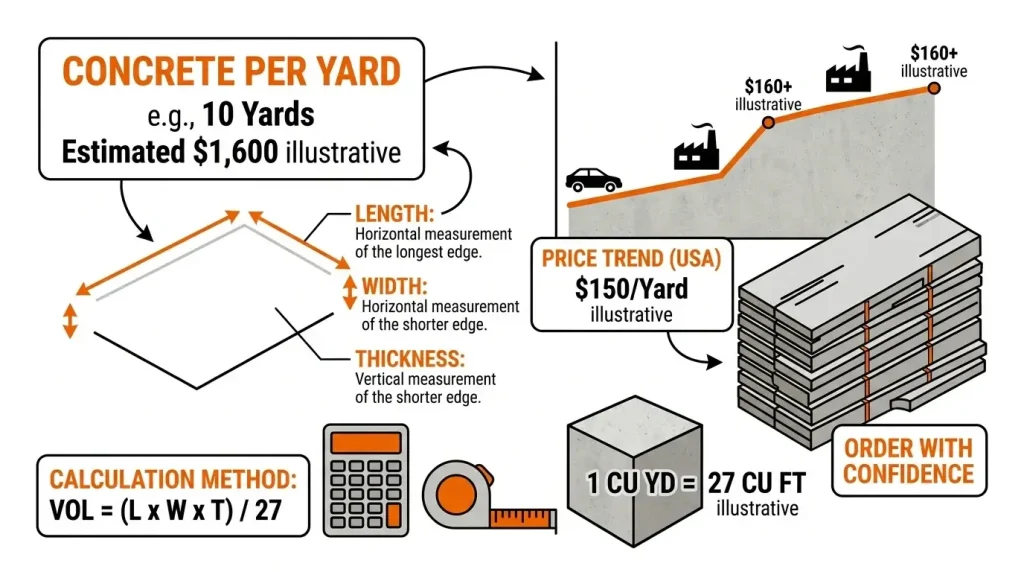
A yard of concrete refers to a cubic yard, which is a measurement of volume, not area. In simple terms, it’s a block of concrete that measures:
- 3 feet long
- 3 feet wide
- 3 feet deep
That equals 27 cubic feet of concrete.
Now here’s where people get confused:
You might be thinking in square feet (like room size), but concrete is always calculated in volume, because thickness matters.
For example, a thin patio and a thick foundation may cover the same area, but they require very different amounts of concrete.
This is exactly why many people either:
- Order too little (causing delays), or
- Order too much (wasting money)
Understanding this one concept can save you a lot of trouble.
Average Cost of Concrete Per Yard
Now let’s get to the question you actually care about: how much does it cost?
In most areas, the average cost of concrete per yard in 2026 falls somewhere between:
$120 and $180 per cubic yard
But here’s the important part:
That’s just the base price.
In real projects, your final cost is almost always higher because of additional charges like delivery, small load fees, or special mix requirements.
For example, if you only need a few yards of concrete, suppliers may charge a short load fee, which increases the cost per yard significantly. On top of that, delivery charges can add another $50 to $150, depending on distance.
So while the advertised price might seem affordable, the actual cost often ends up being higher once everything is included.
Why Concrete Prices Vary So Much
If you’ve noticed that prices change from one project to another, you’re not imagining it. Concrete pricing is not fixed; it depends heavily on your specific situation.
Let’s go through the key factors that affect it.
Grading: Preparing the Ground
Before concrete is even poured, the ground needs to be properly leveled. This process is called grading.
If your site is uneven or sloped, extra work is required to create a stable surface. Without proper grading, the concrete can crack, settle unevenly, or develop drainage issues.
That’s why contractors take this step seriously and why it adds to your overall cost.
Subbase Preparation: The Hidden Foundation
Under every good concrete slab is a solid subbase, usually made of gravel or crushed stone.
This layer might not be visible once the project is complete, but it plays a huge role in durability. It helps with drainage, prevents shifting, and supports the slab over time.
Skipping this step might save money upfront, but it often leads to expensive repairs later, something many homeowners learn the hard way.
Concrete Forms and Finishing
Once the ground is ready, forms are built to hold the concrete in shape while it sets.
After pouring, the surface is finished to achieve the desired look and texture. This could be a simple smooth finish or something more detailed, like a broom or polished surface.
The level of finishing directly impacts labor cost. Basic finishing is relatively affordable, but decorative or detailed work increases the price.
Reinforcement: Strength Where It Matters
Concrete is strong, but it’s not perfect. It can crack under pressure if not reinforced properly.
That’s where materials like steel rebar or wire mesh come in. They add internal strength and help prevent structural issues over time.
For areas like driveways or foundations, reinforcement isn’t optional; it’s necessary. And naturally, it adds to the total cost.
Local Pricing Differences
One of the biggest reasons for price variation is location.
Concrete in one city might cost significantly more than in another due to:
- Transportation distance
- Fuel costs
- Labor rates
- Local demand
This is why you might see completely different prices online compared to what suppliers quote in your area.
Your total cost also depends on your wastage allowance. Our Cost Calculator automatically adds a 5–10% safety margin to your volume so you don’t end up paying for a second delivery truck
How Much Does 1 Yard of Concrete Weigh?
Another detail many people overlook is weight.
A single cubic yard of concrete typically weighs between 4,000 and 4,500 pounds, which is roughly 1.8 to 2 tons.
Why does this matter?
Because weight affects:
- Delivery logistics
- Structural load capacity
- Equipment requirements
For example, a standard concrete truck can only carry a limited number of yards due to weight restrictions. That’s why larger projects often require multiple deliveries.
The exact weight can vary depending on the mix design, water content, and type of aggregate used, but the general range stays consistent.
When you put all of this together, it becomes clear that the cost of concrete isn’t just a simple number; it’s the result of multiple factors working together.
Once you understand these elements, you’re no longer guessing you’re making informed decisions, avoiding unnecessary costs, and planning your project with confidence.
How Many Cubic Feet Are in a Yard of Concrete?
At some point during planning, you’ll likely need to convert measurements, especially if you’re working with dimensions in feet but buying concrete in yards.
Here’s the simple truth:
One cubic yard of concrete is equivalent to 27 cubic feet.
That number comes from the basic dimensions of a yard (3 × 3 × 3). But where this really becomes useful is in real-world calculations.
Let’s say you measure your project in feet length, width, and thickness. Once you multiply those values and get a total in cubic feet, you can convert it into cubic yards by dividing by 27.
This step is often overlooked, and it’s one of the main reasons people miscalculate their concrete needs. They either forget to convert or assume square footage is enough, which, as we discussed earlier, can lead to serious errors.
Once you get comfortable with this conversion, everything else becomes much easier.
How Many Square Feet Does a Yard of Concrete Cover?
This is another question that sounds simple but depends on one critical factor: thickness.
A yard of concrete doesn’t cover a fixed area. Instead, the coverage changes depending on how thick your slab is.
For example:
- At 4 inches thick, one yard covers about 80–81 square feet
- At 6 inches thick, it covers around 50–55 square feet
- At 8 inches thick, coverage drops to roughly 40 square feet
So if you’re planning a patio or floor, the thickness you choose directly affects how much concrete you’ll need and ultimately how much you’ll spend.
This is where many people underestimate their requirements. They calculate the area correctly, but forget that increasing thickness reduces coverage.
A small change in thickness can mean ordering an extra yard or more.
How Much Concrete Can a Concrete Truck Hold?
Once you know how much concrete you need, the next practical question is: how will it be delivered?
A standard concrete truck typically holds 8 to 10 cubic yards of concrete.
That might sound like a lot, but for larger projects, it adds up quickly. For example:
- A driveway may require 10–15 yards
- A house foundation could need 30+ yards
In such cases, multiple truckloads are required.
There’s also something important to keep in mind if your order is too small (say 2–3 yards): suppliers often charge a short load fee because the truck isn’t being used efficiently.
So whether you order too little or too much, it affects your cost in different ways. Finding the right balance is key.
Cost Breakdown of Concrete Materials
When people hear the price of concrete per yard, they often assume it’s just one material. In reality, concrete is a mix of several components, and each one contributes to the final cost.
Understanding this breakdown gives you a clearer picture of where your money is going.
Concrete is primarily made of:
- Cement
- Sand
- Gravel (aggregate)
- Water
Among these, cement is the binding ingredient, while sand and gravel make up the bulk of the volume.
Let’s look at these components a bit more closely.
Cement Cost Per Yard
Cement is usually the most expensive ingredient in the mix, even though it makes up a smaller portion by volume.
The cost of cement can vary depending on quality and market conditions, but generally, it significantly influences the overall price of concrete.
Higher-strength mixes require more cement, which increases cost. That’s why projects like foundations or structural slabs tend to be more expensive than basic walkways.
Gravel Cost Per Ton
Gravel (or crushed stone) is a major component of concrete, often making up 60–75% of the mix.
The cost of gravel typically ranges from $10 to $50 per ton, depending on location and quality.
Although it’s cheaper than cement, the large quantity used means it still plays an important role in total pricing.
It also affects durability. Good-quality aggregate leads to stronger, longer-lasting concrete.
How Much Rock Is in a Yard?
In a standard concrete mix, the majority of the volume comes from aggregate (sand + gravel).
So if you’re buying one yard of concrete, a significant portion of that, often more than half, is made up of rock.
This is why changes in aggregate pricing or availability can impact the overall cost of concrete in your area.
How Much Does a Concrete Patio Cost?
If you’re planning a patio, you’re probably less concerned with “per yard” pricing and more interested in the total project cost.
On average, a concrete patio costs between $6 and $15 per square foot.
The final price depends on several factors:
- Size of the patio
- Thickness of the slab
- Site preparation required
- Finishing style
For example, a simple 10×10 patio may cost around $600 to $1,500, while larger or more detailed designs can go much higher.
What surprises many homeowners is that labor and preparation often cost as much as or more than the concrete itself.
Decorative Concrete Cost (Stamped, Colored, etc.)
If plain gray concrete feels too basic for your project, decorative concrete is usually the next option people consider. It gives you the strength and durability of concrete, but with a much more attractive, customized look.
But here’s where many homeowners get surprised: the price difference between standard and decorative concrete can be significant. And unless you understand what goes into it, it’s easy to underestimate the cost.
Let’s break it down properly.
Why Decorative Concrete Costs More
At first glance, it might seem like you’re just “adding color” or “adding a pattern,” but in reality, decorative concrete involves extra materials, skilled labor, and more time.
Unlike regular concrete, which is poured and finished quickly, decorative work requires:
- Additional surface preparation
- Specialized tools and molds
- Careful timing during finishing
- Skilled craftsmanship
All of these factors increase the overall cost.
Average Cost of Decorative Concrete
In most cases, decorative concrete costs between:
$10 to $30 per square foot
But the final price depends on the level of detail and customization.
Here’s a rough breakdown:
- Basic colored concrete: $8–$12 per sq ft
- Stamped concrete: $12–$20 per sq ft
- High-end decorative finishes: $20–$30+ per sq ft
As the design becomes more intricate and tailored, the cost increases accordingly.
Types of Decorative Concrete
Not all decorative concrete is the same. Each type has its own cost range and use case.
Stamped Concrete
Stamped concrete is one of the most popular options. It uses molds to create patterns that mimic:
- Brick
- Stone
- Slate
- Tile
It’s often used for patios, driveways, and walkways because it gives a high-end look without the cost of real stone.
However, stamping requires precise timing and skilled labor, which increases the price.
Colored Concrete
Colored concrete involves adding pigments to the mix or applying stains after pouring.
There are two main approaches:
- Integral color (mixed into the concrete)
- Surface staining (applied after curing)
This option is usually more affordable than stamping, but still adds noticeable cost compared to plain concrete.
Polished or Decorative Finishes
For indoor floors or modern designs, polished or textured finishes are popular.
These involve:
- Grinding the surface
- Polishing to a smooth finish
- Applying sealers or coatings
They require specialized equipment and multiple steps, which is why they fall on the higher end of the price range.
What Affects Decorative Concrete Cost
Even within decorative concrete, prices can vary a lot depending on your project.
Some key factors include:
Design complexity
Simple patterns cost less, while detailed or custom designs require more labor.
Surface area
Larger areas may reduce cost per square foot, but increase total cost.
Site preparation
If the base isn’t ready, additional work will be needed before decorative finishes can be applied.
Labor expertise
Experienced contractors charge more but poor workmanship can ruin the entire look, so this isn’t an area to cut corners.
Is Decorative Concrete Worth the Cost?
This is the question most people struggle with.
While decorative concrete is more expensive upfront, it offers several long-term benefits:
- Improved appearance and curb appeal
- Higher property value
- Lower maintenance compared to materials like wood or pavers
- Long-lasting durability
For many homeowners, it’s not just about cost it’s about getting a finish that looks premium without constant upkeep.